


Museveni Declares Victory in Uganda Election as Observers Question Legitimacy of Landslide Win
President Yoweri Museveni has claimed a decisive victory in Uganda’s 2026 general election, framing the result as a testament to the enduring strength of his 40-year rule. However, the official Uganda election results 2026, awarding Museveni over 71% of the vote, have been met with immediate rejection from the opposition and unprecedented scrutiny from international observers, who detailed a campaign marred by repression, violence, and digital blackouts. The declaration extends Museveni’s tenure into a seventh term, pushing his total time in power closer to a half-century, while his main challenger, Bobi Wine, denounces the process as a fraud and remains in hiding after a dramatic attempt by security forces to arrest him at his home. The events have cast a long shadow over the credibility of the electoral process in a nation that has not seen a peaceful transfer of power since independence.
Addressing the nation from his country home on Sunday, a triumphant President Museveni declared that the landslide gave “a good taste of the strength” of his National Resistance Movement (NRM) party. “The opposition are lucky,” he stated, as reported by ABC News. “They have not seen our full strength.” He attributed a record-low voter turnout of 52%—the lowest since multiparty politics resumed—to complacency among his own supporters, while simultaneously accusing opposition elements of terrorism and attempting to foment violence. His speech stood in stark contrast to the scene unfolding for his primary rival, Bobi Wine, whose real name is Robert Kyagulanyi.
A Contested Outcome and a Crackdown on Dissent
Even as the electoral commission announced Museveni’s overwhelming win, the opposition narrative told a story of state-backed subversion. Bobi Wine, the 43-year-old musician-turned-politician who secured 24.7% of the official vote, immediately rejected the results as “fake.” His rejection was followed by a direct and alarming confrontation with the state. According to a report from The Globe and Mail, security forces surrounded his home after voting ended, later scaling the fence, cutting power, and breaking in to arrest him. Wine escaped and issued a video statement from an undisclosed location.
“Those so-called results they are declaring are fake, and they don’t in any way reflect what happened in the polling stations,” Wine stated from hiding, capturing the deep distrust fueling the political crisis.
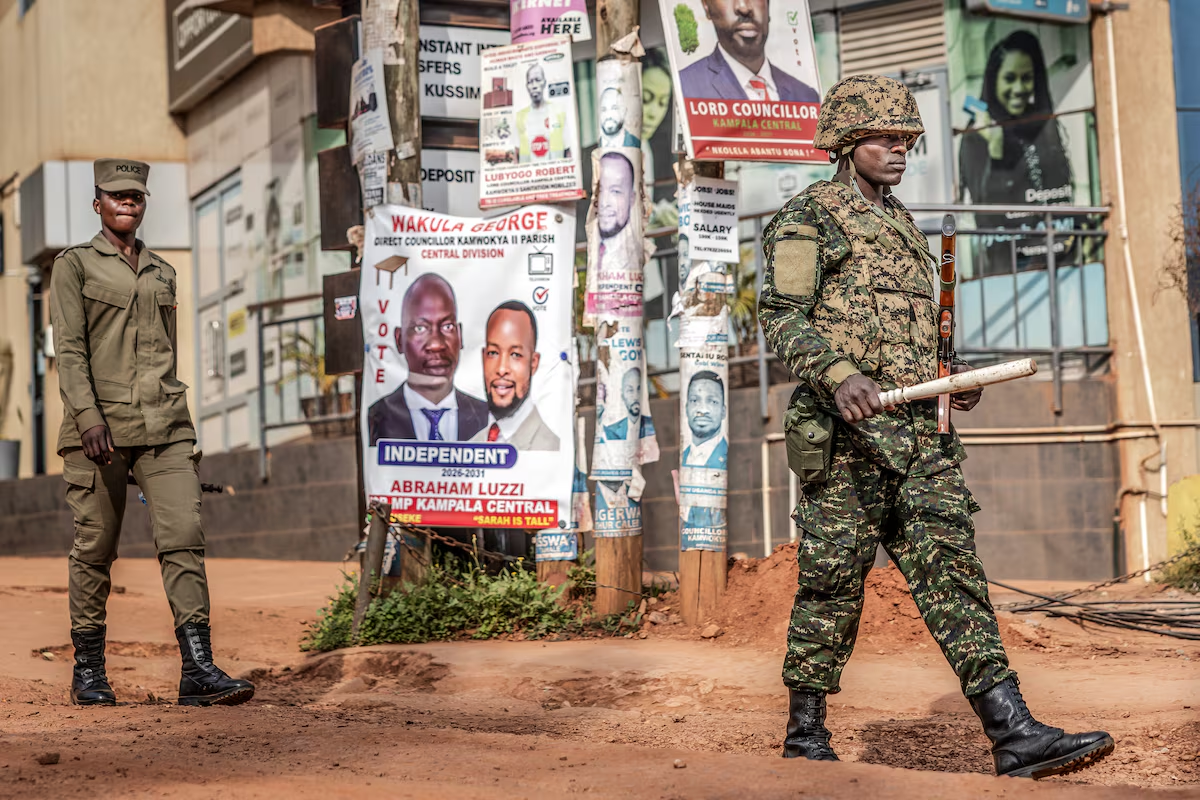 The election period was characterized by severe restrictions that critics argue were designed to ensure a predetermined outcome. The government imposed a days-long nationwide internet shutdown, suspended the work of human rights groups, and saw the widespread failure of biometric voter verification machines, particularly in opposition-leaning areas like the capital, Kampala. These actions, observers note, prevented independent parallel vote tabulation and hampered the ability to document irregularities. Furthermore, the security apparatus maintained a heavy-handed presence throughout, with Wine campaigning under constant threat, often wearing a flak jacket and helmet for protection.
African Union Observers Break Ranks, Detail Systematic Flaws
In a significant departure from its often-acquiescent stance, the African Union (AU) election observer mission led by former Nigerian President Goodluck Jonathan issued a preliminary report casting serious doubt on the election’s fairness. The report meticulously cataloged a range of abuses that created what it described as an environment of fear and mistrust. It noted the illegal deployment of the military during the electoral process, the arrest and abduction of opposition supporters, and the violent dispersal of rallies using tear gas, water cannons, and live ammunition.
The observers also highlighted procedural irregularities that undermined transparency, such as authorities illegally ordering voters to leave polling stations immediately after casting their ballots, contravening laws that permit observation from a distance. The mission concluded that these actions “instilled fear, eroded public trust in the election, infringed on political freedoms and contributed to voter apathy.” Despite this stark assessment, a contradictory message emerged from the AU’s headquarters, where Commission chairperson Mahmoud Ali Youssouf congratulated Museveni and praised Uganda’s “democratic gains,” highlighting the geopolitical tensions surrounding the bloc’s role.
The election “followed a typical authoritarian playbook,” former Botswana President Ian Khama wrote in commentary, arguing that the internet shutdown and the attempt to arrest the opposition leader were signs of a regime insecure in its legitimacy. “You don’t do this as a government if you are secure in your victory.”
The Uganda election results 2026 solidify a political dynasty that has systematically removed all constitutional checks on power. Museveni, 81, who first took office in 1986 after a guerrilla war, has overseen the abolition of presidential term limits and the removal of an age cap, allowing him to run indefinitely. Potential rivals like veteran opposition leader Kizza Besigye remain imprisoned on charges widely seen as politically motivated. Furthermore, Museveni is widely believed to be grooming his son, military chief General Muhoozi Kainerugaba, for succession, suggesting a move towards hereditary rule. For ongoing, in-depth analysis of Uganda’s evolving political landscape, follow the latest developments on Africanewsdesk.net’s Uganda News.
The aftermath of the 2026 vote leaves Uganda at a familiar yet increasingly tense crossroads. While Museveni projects an image of unassailable strength and promises continued stability, a significant portion of the population, particularly the youth who connect with Bobi Wine’s message, views the regime as an entrenched autocracy. The AU observer report, despite its mixed reception within the organization itself, provides a documented indictment of the electoral process that will fuel domestic dissent and international debate for years to come. The path forward appears set for continued repression and legal challenges in courts historically favorable to the state, with little prospect for the peaceful political transition that has eluded Uganda for over six decades.
