

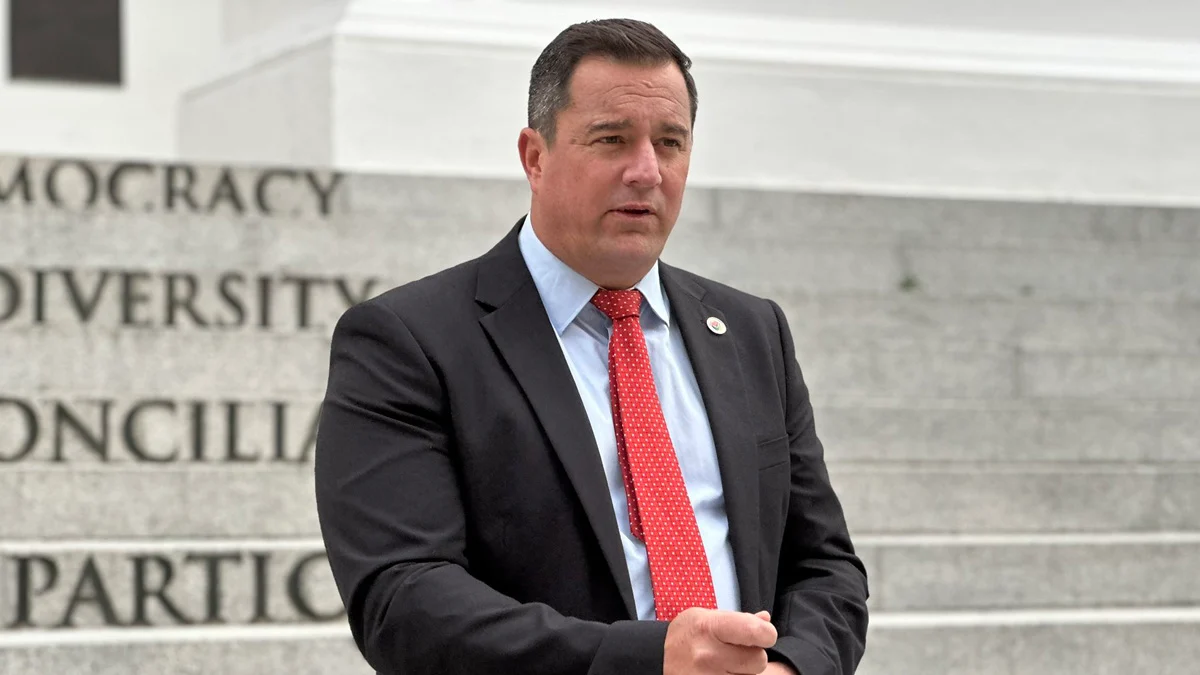
South Africa’s Coalition Government Jolted as DA Leader John Steenhuisen Announces Exit
JOHANNESBURG, South Africa – South Africa’s political landscape was reshaped on Wednesday as John Steenhuisen, leader of the Democratic Alliance (DA), announced he would not seek re-election at the party’s conference in April. The departure of the 49-year-old, who has led the official opposition since 2019 and serves as Agriculture Minister in the national unity government, injects significant uncertainty into the stability of the coalition forged after the 2024 elections. Steenhuisen’s decision, reported by the BBC, follows internal party pressure and public controversies, marking a pivotal moment for both the DA and the fragile alliance with the African National Congress (ANC).
At a press conference, Steenhuisen framed his exit as a move to focus entirely on his ministerial portfolio, specifically the devastating foot-and-mouth disease outbreak crippling the livestock industry. “For the rest of this term of office, I will focus all of my time and energy as minister of agriculture on defeating the most devastating foot-and-mouth disease outbreak our country has ever seen,” he stated. However, analysts and reports from sources like Bloomberg indicate the decision was compelled by a confluence of factors, including a fallout with senior party figures, criticism of his disease management, and allegations—though cleared—of misusing a party credit card. For continuous, in-depth analysis of this political shift and its ramifications, follow our dedicated coverage on South Africa news.
The Unraveling: Internal Pressure and Mounting Controversies
Steenhuisen’s path from presumed unopposed re-election candidate to outgoing leader was swift and underscored deep fissures within the DA. Widely expected to run again, his position became untenable due to several escalating issues. A very public spat with the party’s finance chief, Dion George, revealed significant internal discord over policy directions within the coalition government. Simultaneously, he faced fierce criticism from the agricultural sector, a core DA constituency, with farmers accusing his department of being an “obstacle in a crisis” in managing the foot-and-mouth outbreak that has spread to most provinces.
“Markets don’t like anything that can be interpreted as increasing political uncertainty, but I think there’s some relief that it isn’t a conflict with the ANC, that it seems to be an internal DA issue,” said Henrik Gullberg, a macro strategist at Coex Partners, in comments to Bloomberg. He added that anything undermining the “stability of the GNU and the reform-focused DA is likely to be initially” negative for the South African rand.
The controversy extended to a probe into allegations of abusing a party credit card, which, while clearing him in January, lingered as a reputational burden. Furthermore, as Agriculture Minister, Steenhuisen was tasked with implementing contentious policies like Black Economic Empowerment (BEE) requirements for EU export permits, which strained his relationship with some traditional party supporters. This accumulation of pressures created an environment where a leadership challenge became inevitable, forcing his hand to step aside rather than face a potentially damaging contest.
Succession and Stability: The Future of the DA and the GNU
Attention now shifts to the DA’s succession battle and the implications for the Government of National Unity (GNU). The immediate market reaction—a paring of the rand’s gains—highlighted investor skittishness about political instability, though analysts noted relief that the crisis appeared internal to the DA rather than a rupture with the ANC. The stability of the GNU, a historically fractious but so-far-enduring marriage between ideological opponents, now enters a new phase of testing.
The DA leader has faced “pressure within his party to quit amid differences over policy choices within the coalition government,” Bloomberg reported, pinpointing the core tension between compromise within the GNU and maintaining distinct DA principles.
The leading contender to replace Steenhuisen is Cape Town Mayor Geordin Hill-Lewis, a 39-year-old rising star widely viewed as the architect of the city’s reputation as South Africa’s best-run metro. Hill-Lewis, who has stated he would not run against his friend Steenhuisen, confirmed he would “very seriously” consider running if the position were open. He has ruled out joining the national cabinet, intending to seek a second term as mayor while potentially holding the party leadership—a scenario that would keep the DA’s top figure outside the core of national government. Other potential successors include Communications Minister Solly Malatsi and Basic Education Minister Siviwe Gwarube.
Whoever emerges as the new DA leader will inherit a complex dual mandate: to revitalize the party’s identity and coherence after internal strife, and to redefine its terms of engagement within the GNU. Hill-Lewis has previously stated support for continued coalition participation but insisted “the terms of engagement would have to be improved.” This suggests a potential hardening of the DA’s negotiating stance, which could lead to renewed friction with the ANC. The succession will determine whether the DA moves toward a more conciliatory coalition partner or a more assertive and critical one, directly impacting the government’s ability to pass legislation and implement reforms.
Steenhuisen’s legacy is a mixed one. He led the DA into an unprecedented national coalition, breaking a political taboo and granting the party real executive power for the first time. Moments like his defense of South Africa alongside President Ramaphosa in a tense White House meeting demonstrated the GNU’s potential for unified diplomacy. However, his tenure also exposed the difficulties of managing a broad church of a party while serving in a complex coalition, ultimately culminating in the internal pressures that prompted his exit. As John Steenhuisen moves out of the party leadership, the DA stands at a crossroads. Its next steps will not only determine its own future trajectory but will also be a decisive factor in the stability and effectiveness of South Africa’s experiment with coalition government at the national level. The April conference will now be a seminal event, shaping the nation’s politics for years to come.
